Return to Spring 2015
Know Your Characters
This an occasional series introducing some of the basic words and expressions used in Zen practice in their original form, as Chinese characters. Although the Kwan Um School of Zen is a Korean school, the root vocabulary of Zen is classical Chinese, shared by all traditions in China, Korea, Japan, and Vietnam (and now around the world).
Character 3: Bop
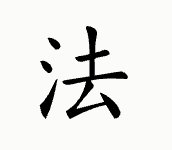
Bop (Korean)
Fa (Mandarin)
Bop or Fa is the Chinese translation of the Sanskrit term “dharma.” More literally, in Chinese, it means “the law.” The character has an interesting etymology: it’s the combination of the character 去, meaning “to go,” with the radical 氵 for water—we might say the three drops on the left represent three drops of water. A poetic interpretation of this character would be the law, or dharma, is like water flowing—a very common metaphor in Chinese thought.
Because classical Chinese has no plural forms, 法 means “dharma” or “dharmas,” depending on context. “Dharma” refers to the great body of the Buddha’s teaching, that is, the Buddhadharma:
佛 法
Buddha Dharma
“Dharmas” is another way of describing individual manifestations of the teaching, which is really the same thing as saying any individual object, being, or experience. In early Buddhism, the Abhidharma (epitome of dharma) tradition, a highly detailed form of analysis of mental experience, developed categories of many different dharmas—that is, different objects of mind, or “possible cognitive experiences.” This later developed into the Mind-Only school, or Yogacara, a major influence on the development of Zen. This Mind-Only teaching is reflected in a piece of calligraphy displayed next to the main altar at Providence Zen Center, which reads:
無 法 心 外
Without / dharmas / mind / outside
[There are] no dharmas outside the mind
Zen Master Seung Sahn often referred to the kong-an, “The ten thousand dharmas return to the One. Where does the One return?”:
萬法歸一
Ten thousand / dharmas / return / one
一歸何處?
One / returns / what / place?
In the Chogye International Zen Center, the calligraphy behind the Buddha in the dharma room includes these two lines.
One of the interesting things about the expression “Ten thousand dharmas” is that it echoes a Taoist expression often used in Chinese philosophy and poetry, 萬事 or “Ten thousand things.” This is really another way of saying “all things” or “everything”—that is, everything that exists, the world in all its dizzying variety and multiplicity. In a Buddhist context, these expressions are synonymous, and Chinese Buddhist poets like Han Shan use them almost interchangeably.
Although it would be more accurate to use the Chinese definition, “law,” when translating Chinese Buddhist texts, English translators from very early on decided instead to revert to the Sanskrit word “dharma” instead. This is most likely because the word “law,” in English, can’t capture all the variations of meaning in “dharma.” In Chinese, 法 can mean “method” or “principle” (somewhat like our use of the term in a phrase like “law of thermodynamics) but in English “law” almost always has the connotation of something that has been invented and imposed by a government or other organization. In the Zen tradition, especially, “dharma” means something that can be transmitted and discovered, but never imposed from the outside. As So Sahn Tae Sa puts it in The Mirror of Zen:
禪門惟傳見性法
Zen / gate / only / transmit / see / self-nature / dharma
The Zen tradition only transmits the dharma of seeing your true nature.
法 is a very easy character to learn to write. Try it! Remember that 氵(water) goes on the left and 去 (to go) goes on the right. That’s dharma, flowing like water. Can you taste it?
Character 4: Kwan
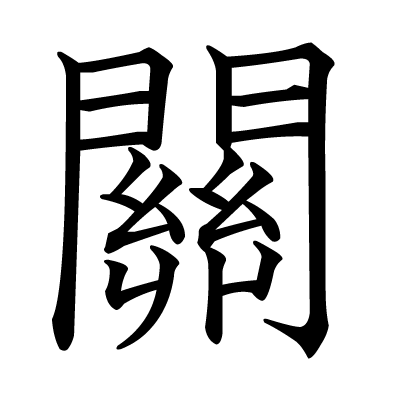
Kwan (Korean)
Guan (Mandarin)
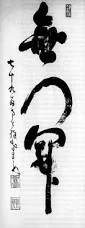
This character looks more intimidating, doesn’t it? Kwon or Guan means “gate,” “checkpoint,” or “border entry,” as in Zen Master Seung Sahn’s Ten Gates, or the famous collection of kong-ans, the Mu Mon Kwon, which is sometimes translated as “No-Gate Checkpoint,” “Gateless Gate,” “Gateless Barrier,” and so on.
In this case, as with many Chinese characters (but not all), the different parts of the character can explain how we understand this word. Kwon is made up of two parts: 門, which means “door” or “gate,” and is pictographic, meant to look like two sides of a swinging door, and an archaic form of 幺, which means “to weave with threads.” So this word combines the meaning of “gate” with a sense of connection or intersection. In ancient Chinese, it referred to a frontier pass or checkpoint where documents or identification would have to be produced. In modern Chinese, it is used in the common expression guanxi, which means “connections” or “relationship.”
Kwon is an apt word for Zen teaching, because it embodies the spirit of kong-an practice, where the student and teacher meet at a checkpoint (the kong-an interview) where the student must demonstrate her or his understanding. If the teacher approves, the student can go forward. But, of course, originally there is no teacher, no student, no checkpoint and nothing to check! The title of the Mu Mon Kwon (which is a play on words based on the name of the monk who compiled it, Mumon or Wumen) conveys this sense:
無 門 關
Without/no gate checkpoint
Mumon explains this further in his introductory poem. Look for the way he uses “gate” and “checkpoint” as parallel expressions:
大道無門
Great / way (Tao) / without / gate
The great way has no gate;
千差有路
Thousand / directions / is, has / road
Its roads go in a thousand directions.
透得此關
Cross, travel through / attain / this / checkpoint
Pass through this checkpoint,
乾坤獨步
Heaven and earth, the world / alone / walk
And you will walk alone between heaven and earth.
Zen Master Seung Sahn’s book Ten Gates also contains an introductory poem called “Ten Gates,” which ends like this:
Originally, there is nothing.
How do you open and close?
The mouse eats cat food but the cat bowl is broken.
DO!
Through the gates—north south, east west.
The “Do” here is the character 道, that is, Tao, path, or way, pronounced “Do” in Korean. (Stay tuned for another edition of Know Your Characters about 道 and its many uses).
Here is a highly stylized calligraphy of the characters Mu Mon Kwon by the Japanese calligrapher Tōjū Zenchū.